
Global rating agency Moody's on Monday raised India's growth forecast for 2024 calendar year to 6.8 per cent, from 6.1 per cent estimated earlier, on the back of 'stronger-than-expected' economic data of 2023 and fading global economic headwinds. India's real GDP expanded 8.4 per cent year-over-year in the fourth quarter of calendar year 2023, resulting in a 7.7 per cent growth for full-year 2023. Capital spending by the government and strong manufacturing activity have meaningfully contributed to the robust growth outcomes in 2023, Moody's Investors Service said.

There appears to be a growing perception among the political class that faster growth will not create jobs fast enough and, therefore, welfare spending needs to be drastically increased, says T T Ram Mohan.

'Even before the outbreak of the flu, it had become clear that the tax revenue numbers for 2019-2020 were overestimated,' observes A K Bhattacharya.

While presenting her 2021-22 Union Budget, Finance Minister Nirmala Sitharaman had set a fiscal deficit target of 6.8 per cent of nominal gross domestic product (GDP) against the 2020-21 Revised Estimate of 9.5 per cent. The fiscal correction in the upcoming 2022-23 Union Budget is unlikely to be that steep. Even as discussions among top Budget-makers are ongoing, the fiscal deficit target for 2022-23 may likely be in the range of 6.5-6.8 per cent.

The government had no option but to cut spending to meet its borrowing targets.

'We need to put aside our anxieties about the Budget for now and possibly for long, and carry on as best as we can,' advises Shreekant Sambrani.

The government on Tuesday announced setting up of hubs to promote exports through e-commerce medium in public-private-partnership (PPP) mode and initially 10-15 hubs will be established. Finance Minister Nirmala Sitharaman said that these hubs, under a seamless regulatory and logistic framework, will facilitate trade and export-related services under one roof. "To enable MSMEs (micro, small and medium enterprises) and traditional artisans to sell their products in international markets, e-commerce export hubs will be set up in PPP mode," she said.

The National Council of Applied Economic Research also says that the fiscal deficit will overshoot budget target to touch 4.7 per cent of GDP in 2004-05.

'Understand how wedding expenses fit into your overall financial situation.' 'Evaluate how different levels of spending will impact other goals like retirement, travel, or housing.'

The 1.4% decline projected for 2025 is driven by a 5.6% (72,000) dip in the strength of railway employees to 1.2 million by next year.

Rajeev Mehta, chief executive for IT services, believes this is due to a few client-specific issues, saying the overall business environment continues to look good.

The average cost of data breaches in India reached $2.18 million in 2023, marking a 28 per cent increase since 2020, according to the Reserve Bank of India's (RBI) Currency and Finance report for 2023-24. The report said that India's average data breach cost was still below the global average. The most common attacks in India are phishing which was at 22 per cent and stolen or compromised credentials was 16 per cent. The automotive industry is highly vulnerable to cyber attacks, whereas the banking and financial services sector, benefiting from stringent regulations, enjoys comparatively stronger protection.
The rise in the fiscal deficit, which is a reflection of the government's borrowing, was mainly on account of subdued tax collection. The revenue deficit also rose to 3.27 per cent, up from the revised estimate of 2.4 per cent of the GDP.

Ecommerce firm Amazon has infused ~1,600 crore into its India entity Amazon Seller Services, according to its regulatory filings. The funding comes at a time when the company is seeing opportunities in emerging geographies, including India. The regulatory filings are dated April 15. This is the second time in five months that Amazon invested in its India arm Amazon Seller Services. Before this, Amazon had infused over ~1,000 crore into its Indian entity this year.

The Child Protection Services programme under the Integrated Child Development Services was increased to Rs 1,500 crore from Rs 925 crore.

The company has the largest car park in EVs in India, estimated to be around 170,000 units. As a pilot, it has already started work with used online car marketplace Spinny.

Women and children have been given short shrift with these crucial sectors facing substantive budgetary cuts, discovers Rashme Sehgal.

Brokers believe that the higher charges may not completely deter investors from taking bets in F&O but could help cool down some activity, as the threshold to break even rises.

Gold, a safe-haven bet, is likely to continue its record-smashing journey in the New Year, rising to Rs 85,000 per 10 grams and even Rs 90,000 level in domestic markets if geopolitical tensions and global economic uncertainties continue.
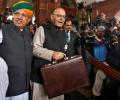
Pensioners, India Inc may get tax breaks in Budget

The Budget allocation for Ministry of Agriculture and allied activities has grown by 114% since 2010-11

The government wants new domestic companies to set up their manufacturing units fast and hence the concessional tax rate of 15 per cent has been extended by a year till March 2024, revenue secretary Tarun Bajaj said on Friday. Stating that direct and indirect tax collections are going up and have good buoyancy, Bajaj said it means that the corporate sector is also doing well, and India's tax to GDP ratio could be "highest ever" in the current year. The Budget 2022-23 presented on February 1 has proposed that the concessional 15 per cent corporate tax rate would be available for one more year till March 2024 for newly incorporated manufacturing units.

For 2017-18 and 2018-19, investors are better off focusing on the quality of measures announced in the Budget and outside it rather than on the Budget numbers themselves, says T T Ram Mohan.

The scarcity of resources is particularly evident in the case of Rajasthan compared to many other states.

One waits to see where Munjya land though rest assured, a lifetime score of over Rs 50 crores is guaranteed from this point on.

The budget-making exercise offers golden opportunities despite challenges, observes Shankar Acharya, former chief economic adviser to the Government of India.

The government had breached its fiscal deficit target given in the Budget for 2017-18 in November itself, touching 112 per cent of the limit.

India's gross tax revenue, comprising both direct and indirect taxes between April and July, reported a growth rate of merely 2.8 per cent to Rs 8.9 trillion compared to the same period a year ago, as shown by government data on Thursday. This growth was dampened by direct tax figures, offsetting the healthy growth in goods and services tax collections and Customs duties. While net tax revenue contracted by 12.6 per cent to Rs 5.8 trillion up to July, accounting for 25 per cent of the Rs 23.3 trillion full-year target, this could be attributed to the increased tax devolution to states during the period.

While most experts suggest the government loosen its purse strings and not worry about the fiscal deficit in a pandemic impacted year, it will be a tightrope walk for the government to increase spending without going overboard.

'The vision now is not just to look at national highways as a number of kilometres, but quality as well.'

'The finance minister in her Budget speech should spell out how exactly she intends to get back to the 7% track, and the hard decisions she intends to take in order to adjust to the realities of a slowing economy until growth momentum returns,' suggests T N Ninan.

Fiscal deficit in first half of FY19 has already reached 95.3 per cent of full-year budget estimates.

The Budget is remarkably coherent.

Foreign portfolio investors have been net positive since the Union Budget

The situation raises concerns about whether the promised freebies will once again push the state into a revenue deficit.

If there is no third wave of the pandemic, the fiscal position of the Centre and the states will be much better than budgeted for FY22 and the states may garner Rs 60,000 crore more in tax collections at Rs 8.27 lakh crore this fiscal year than they have budgeted, a report said. The report by SBI Research on Monday bases its optimism on GST collection so far this fiscal, which has been the best ever in spite of the fact that the two months bore the maximum brunt of the second wave -- with April setting a record Rs 1.41 lakh crore and May collection a tad low at Rs 1.03 lakh crore. The report also said overall government finances do not look overstretched as GST collections have continued to maintain pace so far and the additional fiscal impact arising from free vaccination and more food supplies will only be around Rs 28,512 crore.

The suspected undisclosed income in these cases could reach as much as Rs 15,000 crore.

The final Budget for the fiscal is likely to be tabled in July after formation of the new government.

The government on Thursday rolled out the internship programme on a pilot basis that will provide a total annual financial assistance of Rs 66,000 to those in the age group of 21-24 years, and aim to cover one crore youth over five years.
